

Are THC Drinks Healthier Than Alcohol? The Hangover-Free Exit Route
There's a question floating around the highlands, drifting through the mist near Tangilime Grove, bouncing off the cliffs at Rocket Peak: Are THC drinks healthier than alcohol? It's the kind of question that doesn't have a postcard answer—no single photo captures it. But we've mapped the terrain. We've counted the calories, traced the liver pathways, and compared the mornings-after. What we found is this: healthier depends on what you're measuring, but if you're tired of hangovers and looking for an exit door from ethanol's grip, the highlands have built you one.
Let's walk through it together. No corporate jargon, no hand-waving. Just the data, the trade-offs, and what it looks like when you swap a standard drink for a can that weighs in at 15 calories and zero regrets.
The Short Answer (Because It's Nuanced)
For most adults, THC drinks cut calories and next-day hangxiety versus alcohol—but they still impair you, can nudge heart rate and sleep architecture, and aren't risk-free. Choose dose, sugar, and timing wisely. Neither is universally "safe"; one just skips the ethanol.
That's the headline. Now let's unpack the suitcase.
The World Health Organization recently updated its stance: no level of alcohol consumption is safe for our health. Not "low risk." Not "moderate is fine." Zero safe threshold. Meanwhile, low-dose THC beverages—like Highlandia's 5mg cans—sidestep ethanol's calorie load and the biological cascade that leaves you queasy, foggy, and regretting the third glass of wine. But sidestepping one set of risks doesn't erase all risks. THC impairs driving and coordination while active, interacts with some medications, and isn't suitable for everyone (pregnancy, certain heart conditions, youth). The question isn't which is harmless. It's which trade-offs fit your life.
Calories, Sugar, and Macros: The Label Math
Let's start with the numbers you can see on a Nutrition Facts panel, because this is where THC drinks make alcohol look like it's carrying extra luggage.
Alcohol's Calorie Baggage
Ethanol delivers roughly 7 calories per gram—nearly as dense as fat (9 cal/g), and more than carbs or protein (4 cal/g each). A standard U.S. drink contains 14 grams of ethanol, which pencils out to about 98 calories from alcohol alone, before you add the beer's malt sugars, the wine's residual sweetness, or the margarita's triple sec. Two glasses of wine or two beers can easily stack 200–300+ calories onto your evening, and alcohol has a sneaky way of making the snack drawer look irresistible.
Use the NIAAA's calorie calculator if you want to see your weekly total—it's often higher than you'd guess.
THC Drinks: The Calorie Disappearing Act
THC itself has no caloric value; it's dosed in milligrams, not grams. The calories in a THC beverage come entirely from its formulation—sweeteners, fruit essences, bubbles. That means brands can dial it down to nearly nothing.
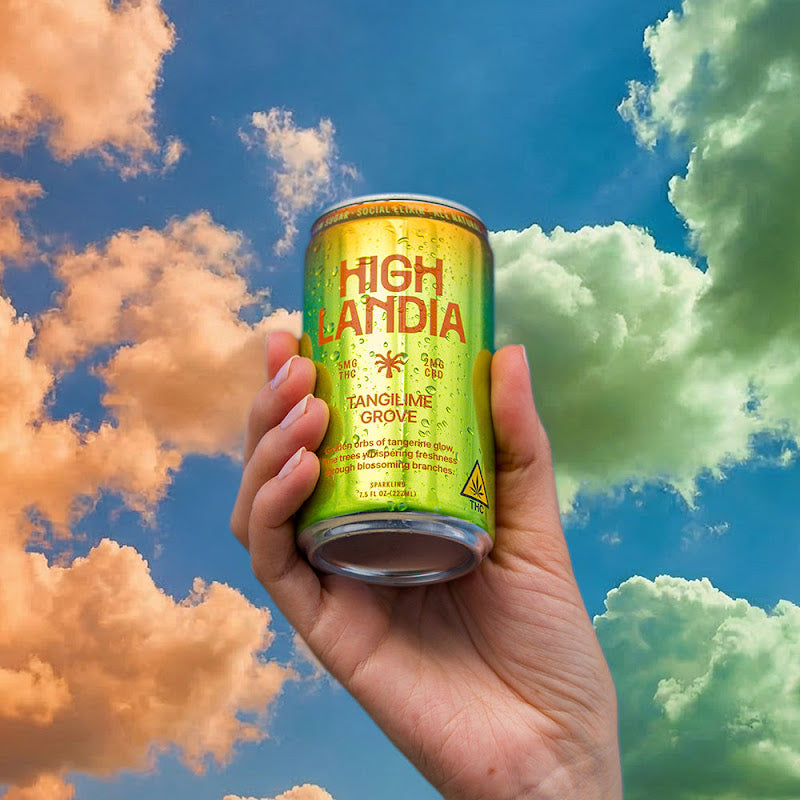
- Low-calorie by design: Highlandia's Tangilime Grove sits at 15 calories and 4 grams of organic cane sugar per 7.5 oz can—less than a single Hershey's Kiss.
- Across the category: Most low-dose THC seltzers and social tonics land between 0 and 30 calories per can—still a fraction of a margarita.
The practical swap: Replace a 150–250 calorie alcoholic drink with a 15–30 calorie THC seltzer, and you've just saved 120–220 calories per serving. Over a week, that's the difference between maintaining and slowly drifting upward on the scale.
Sugar: A Moving Target
Not all THC drinks are created equal here. If weight management or blood sugar matters to you, read the label. Zero-sugar formulations exist; some brands—Highlandia included—use a touch of organic cane sugar for real flavor. Alcohol, meanwhile, often hides its sugar story—dry wines are low, but cocktails and flavored malt beverages can pack 20+ grams per serving.
Liver and Kidney Load: What Your Organs Are Processing
Your liver doesn't care about brand storytelling. It cares about what molecules it has to break down at 2 a.m. while you sleep. Here's where the chemistry diverges sharply.
Alcohol: The Ethanol Gauntlet
When you drink alcohol, your liver converts ethanol into acetaldehyde—a toxic compound that damages cells and generates oxidative stress. Over time, this drives a spectrum of alcohol-associated liver disease, from fatty liver to cirrhosis. Ethanol also triggers a diuretic effect by suppressing vasopressin, leaving you dehydrated and contributing to that morning headache and cotton-mouth. Your kidneys work overtime flushing excess fluid; your liver juggles acetaldehyde and metabolic cleanup.
Even moderate drinking stresses these pathways. There's no free pass.
THC Drinks: A Different Road
Low-dose THC beverages contain no ethanol. You've just removed the primary driver of alcohol-associated liver injury from the equation. THC itself, at the low doses found in a 5mg can, does not appear to carry the same hepatotoxic risk profile as ethanol.
That said, context matters. CBD—often paired with THC in beverage formulas—has been linked to elevated liver enzymes at much higher therapeutic doses, and cannabinoids interact with the liver's cytochrome P450 enzyme system, which can affect how your body processes certain medications. If you're on prescriptions metabolized by CYP3A4 or CYP2C9, talk to your clinician before making THC drinks a regular ritual.
But if the question is "Does a 5 mg THC seltzer hammer my liver the way two IPAs do?" the answer is no. Not even close.
Hangovers, Sleep, and the Morning-After Reckoning
This is where the highlands earn their reputation as a gentler place to spend an evening.
The Alcohol Hangover: A Biological Cascade
A classic alcohol hangover is a multi-system disaster. Acetaldehyde toxicity. Dehydration from vasopressin suppression. Inflammatory cytokines. Disrupted sleep architecture—alcohol may help you fall asleep faster, but it fragments your sleep and suppresses REM cycles, leaving you groggy even after eight hours in bed. Then there's "hangxiety"—the rebound cortisol and glutamate surge as your brain recovers from alcohol's depressant effects.
Studies confirm that even after your blood alcohol returns to zero, next-day cognitive performance and reaction times remain impaired. Darker spirits with more congeners (bourbon, whiskey) worsen the severity, but clear vodka doesn't grant immunity—the ethanol itself is the issue.
THC Drinks: A Quieter Exit
Because THC beverages contain no ethanol, they skip the entire acetaldehyde-dehydration-inflammatory hangover cascade. A 2022 systematic review found little reliable evidence of "next day" cognitive or psychomotor impairment beyond eight hours post-THC use, though study designs and doses varied widely. Translation: most people wake up clear-headed after a low-dose THC evening, especially if they finish their can three or more hours before bed.
Sleep is murkier. Some users report THC helps them fall asleep at low doses; others find it disrupts sleep architecture at higher doses or when used late. The research on cannabis and sleep remains mixed and dose-dependent—far less conclusive than alcohol's well-documented sleep fragmentation. If next-day clarity and avoiding the 9 a.m. headache matter to you, THC drinks have a structural advantage. But timing still matters.
Where THC Drinks Beat Alcohol (and Where They Don't)
Let's get specific. No hand-waving, no "it depends" without the details.
Clear Wins for THC Drinks
- Calories and sugar flexibility: Most low-dose THC seltzers deliver 15–30 calories; alcohol starts at ~98 before mixers. If weight or metabolic health is on your radar, this is a straightforward swap.
- No ethanol hangover biology: Acetaldehyde, dehydration, and inflammatory cascades? Not on the itinerary in Highlandia. Users consistently report milder mornings.
- Liver stress: Removing ethanol removes the primary driver of alcohol-associated liver disease. Long-term, that's a meaningful reduction in organ load.
- Predictable dosing: Every can states its THC content in milligrams. You can titrate your experience with precision—something alcohol's variable ABV and pour sizes make harder.
Where THC Drinks Don't Win (or It's Complicated)
- Acute impairment: THC impairs reaction time, attention, and coordination while active. Don't drive. Don't operate machinery. Same rules as alcohol, different molecule.
- Onset and duration: THC drinks often kick in within 15–30 minutes, but full effects can build for an hour or more, and the experience can last 4 hours or more based on how much you drink. Stacking doses too quickly is a common rookie mistake.
- Sleep quality evidence: Alcohol definitively wrecks your sleep architecture. THC's impact is less clear—some benefit, some neutral, some disruption depending on dose and timing. More research needed.
- Special populations: THC and alcohol both contraindicate pregnancy. THC can elevate heart rate—caution if you have cardiovascular risk factors. CBD interacts with many medications. Always check with your clinician if you're on prescriptions or have underlying conditions.
- Legal and workplace variability: Alcohol is federally legal and workplace-predictable (don't show up drunk). Cannabis law is a patchwork, and some employers still test for THC metabolites days after use.
Bottom line: "Healthier" is contextual. On calories, liver load, and classic hangovers, THC drinks usually win. On universal safety and suitability, neither substance wins—abstinence is the only zero-risk path. Choose your trade-offs deliberately.
How Highlandia Fits a Damp or Sober-Curious Lifestyle
The "damp" movement—conscious moderation, not strict abstinence—is reshaping how people think about social rituals and evening unwind routines. Retail data shows THC beverages growing 135% year-over-year, with the strongest velocity in liquor and convenience channels. Translation: people are actively seeking alcohol alternatives that still offer a buzz, a ritual, a moment of elevation.
That's exactly the terrain Highlandia was designed for.
The Nutritional Passport
Our 5 mg sparkling elixirs—whether you're wandering Tangilime Grove, scaling Rocket Peak, or drifting through Cottondew Clouds—clock in at 15 calories and 4 grams of organic cane sugar per 7.5 oz can. That's less caloric weight than a handful of tortilla chips. For travelers who track macros or simply want to wake up without regret, the math is refreshingly simple.
Dosing as a Destination Guide
We publish a Traveler's Dosing Guide on every product page because predictability matters when you're charting a course for your evening. A 2.5–5 mg "City Cruise" offers a gentle lift—present, not overwhelming. A 5–10 mg "Scenic Route" deepens the landscape. Start low, wait at least 60 minutes, and adjust from there. You're the cartographer of your own experience.
Third-Party Testing and Transparency
We test every batch through independent labs and publish Certificates of Analysis because trust isn't built on vibes—it's built on data. You should know exactly what's in the can you're cracking, down to the milligram. That's table stakes for a premium experience and a core principle of harm reduction.
The Ritual, Reimagined
Replacing alcohol isn't just about swapping molecules. It's about preserving the social cue—the crack of a can, the fizz, the excuse to pause and transition from "work mode" to "evening mode." Highlandia honors that ritual. We just built a version where the next morning doesn't punish you for it.
The Honest Travel Advisory
Let's close with what we tell every traveler before they board.
THC drinks are not risk-free. They impair you. Don't drive, don't mix with alcohol, and don't hand them to anyone under 21 or anyone pregnant. Store them securely away from kids and pets. If you're on medications—especially those metabolized by liver enzymes—talk to your doctor before making this a regular stop on your calendar. Some people shouldn't travel to Highlandia at all, and that's okay. Know your own map.
But if you're weighing THC drinks against alcohol on the axes that matter for daily wellness—calories, liver load, next-day clarity, and freedom from the hangover cycle—the data tilts toward the highlands. You're cutting 100–200+ calories per serving. You're removing ethanol's toxic metabolites from your liver's to-do list. You're waking up without the fog, the headache, or the hangxiety. And you're doing it with clear dosing, third-party testing, and a flavor experience that doesn't taste like compromise.
The immigration policy in Highlandia is famously relaxed. No one's checking your credentials, no one's judging your past drinking habits. We're just offering a portal to a place where evenings soften without mornings breaking. Where a 15-calorie can delivers the ritual and the elevation, minus the biological disaster. Where "healthier" isn't a marketing claim—it's a set of measurable, honest trade-offs you get to evaluate for yourself.
Your Boarding Pass
The question wasn't whether THC drinks are perfect. Nothing you consume for a buzz is. The question was whether they're healthier than alcohol, calorie by calorie, hangover by hangover. And on those terms—with full transparency about what "healthier" means and doesn't mean—the answer is yes, for most adults, most of the time, when chosen and dosed wisely.
You've earned the detour. The trail to Tangilime Grove starts with a single crack of a can. We'll see you in the highlands, where the weather is pleasantly unreal and tomorrow morning is still your friend.
Discover the Highlandia difference. Explore our lineup of low-calorie, precisely dosed THC drinks and find the flavor-world that fits your evening. No ethanol. No hangover. No apologies required.
Read more
You've seen them in coolers at the dispensary, on shelves at taprooms, maybe even at your corner store. THC drinks are everywhere now—sales topped $1 billion in 2024—and if you're wondering whether...
Here's the question every traveler asks before boarding: How long until I arrive? Fair. Reasonable. Nobody books a flight without knowing whether it's a twenty-minute hop or a six-hour red-eye. The...